
Scrying for Beginners: The Ancient Art of Seeing What Your Eyes Can't Show You
The neuroscience of why staring into darkness produces visions, the Aztec mirror that changed Western magic, and how to have your first real scrying experience tonight

The obsidian mirror was the size of my palm and cost fourteen dollars at a crystal shop in Sedona.
I bought it on a whim — the same kind of whim that makes you grab a magazine at the checkout counter because the cover caught your eye. The woman behind the counter wrapped it in black velvet and said, “Be careful with this one. It’ll show you things you’re not ready for.” I smiled politely and thought she was being dramatic. Shopkeepers in Sedona say things like that. It’s part of the ambiance. I put the mirror in my bag between a water bottle and a half-eaten protein bar and drove three hours home without thinking about it again.
It sat on my dresser for two months. Just a round black disc, catching the overhead light, reflecting nothing I recognized. I’d pick it up sometimes when I was getting dressed, turn it over in my hands, put it back down. I kept it the way you keep a beautiful object that you don’t quite know what to do with — because getting rid of it felt wrong, even though using it felt impossible.
Then one night — bad night, the kind where your brain has decided to process three years of suppressed anger between midnight and 4 AM — I was sitting on the edge of my bed, unable to sleep, and I picked it up. Not with any ritual intention. Not with candles or incense or a carefully curated playlist. I just picked it up and looked into it because it was dark and I was tired and the surface was the same kind of empty I felt inside.
I don’t know how long I stared. Five minutes? Twenty? Time does something strange in those moments, and I didn’t have a clock facing me. But at some point, the surface of the mirror stopped being a surface. It became a depth. Like looking through a window that had been painted black and someone slowly, slowly wiped the paint away from the other side. Not images, exactly. Not yet. A sense of movement. A feeling of something behind the darkness that was different from the darkness itself.
And then a face that wasn’t mine.
I dropped the mirror. My heart was hammering. My hands were shaking. And the most rational part of my brain was already constructing explanations — it was 3 AM, I was exhausted, I was experiencing pareidolia, the human tendency to see faces in random patterns. All of those things were true. And none of them accounted for the specificity of what I’d seen, or the calm that settled over me in the minutes afterward, or the fact that the face belonged to my grandmother, who had died when I was eleven and whom I hadn’t consciously thought about in weeks.
I didn’t try scrying again for almost a year. Not because I was afraid of it. Because I’d done it wrong — no preparation, no protection, no framework for understanding what happened — and I knew that approaching it correctly would require me to take it seriously. Which meant taking myself seriously as someone who could do this. Which was, at the time, the harder thing.
Here’s what nobody tells you about scrying: it’s not a special ability. It’s the oldest and most scientifically documented altered state of consciousness humans have ever practiced. And the reason most people fail at it has nothing to do with psychic gifts and everything to do with the fact that no one taught them what’s actually happening in their brain when they gaze into darkness.
Your Brain Is Already a Scrying Mirror
Let’s start with the neuroscience, because this is where scrying stops being mystical hand-waving and starts being one of the most fascinating intersections of ancient practice and modern brain science.
In the 1930s, German psychologist Wolfgang Metzger began experimenting with what he called the Ganzfeld — German for “complete field.” He discovered that when subjects gazed into an unstructured, uniform visual field — no patterns, no edges, no variation — their brains did something remarkable. Within minutes, their EEG patterns changed. They began hallucinating. Not because anything was wrong with them, but because the brain, deprived of structured sensory input, starts generating its own.
A 2024 study published in Scientific Reports (Shenyan et al.) confirmed and expanded this: when visual input becomes too uniform, the thalamus progressively decouples from the cortex. Bottom-up sensory signals weaken. Top-down processing — the brain’s internal prediction engine — intensifies. The default mode network, associated with imagination, memory, and self-referential thought, becomes more active. In plain language: when you remove external visual structure, the brain fills the void with internally generated imagery. The imagery ranges from simple geometric patterns to complex, vivid, dream-like scenes featuring faces, landscapes, and symbolic content.
This is exactly what happens when you stare into an obsidian mirror. Or a bowl of dark water. Or a crystal ball. Or a candle flame. The tool creates the Ganzfeld condition — a uniform, low-structure visual field — and the brain does the rest. Every scrying tradition in history, across every culture, independently discovered the same neurological principle: give the brain an empty visual canvas, and it will paint on it.
But here’s where it gets interesting, and where the neuroscience alone stops being sufficient explanation. The imagery that emerges during scrying isn’t random. It isn’t the equivalent of television static. Study after study on Ganzfeld-induced experiences shows that the visions are meaningful, symbolic, and frequently relevant to the scryer’s emotional state, concerns, and questions. The brain isn’t just generating noise. It’s surfacing material from below the threshold of conscious awareness — memories, patterns, intuitive knowledge, emotional truths — in a visual language that the conscious mind doesn’t normally access.
This is what the Aztec priests knew. What Nostradamus knew. What the Greek oracles at Delphi knew. Not the neuroscience — the practical application. That if you create the right conditions, the mind shows you what you need to see. And if you learn to read what it shows you, you have access to a form of knowing that your rational daytime mind can’t replicate.
If you’re already thinking about trying this — and you should be — the tools are simpler than you’d expect. A polished obsidian scrying mirror with stand is the most traditional entry point and my personal recommendation: four inches of volcanic glass so dark it looks like a window into nothing, which is exactly the point. If crystal resonates more with your practice, a dream amethyst crystal sphere combines the scrying surface with amethyst’s well-documented association with intuitive amplification. And you’ll want a dedicated journal from the start — scrying visions fade like dreams, and the patterns only emerge when you record them consistently. The rest of what you need (a candle, a dim room, twenty minutes) you already have.
The Mirror That Changed Western Magic
The most famous scrying mirror in history sits in a glass case in the British Museum in London. It’s about seven inches across, perfectly circular, polished on both sides, and made of obsidian — volcanic glass so dark it looks like a hole in the world. An inscription stored with it reads: “The Black Stone into which Dr Dee used to call his Spirits.”
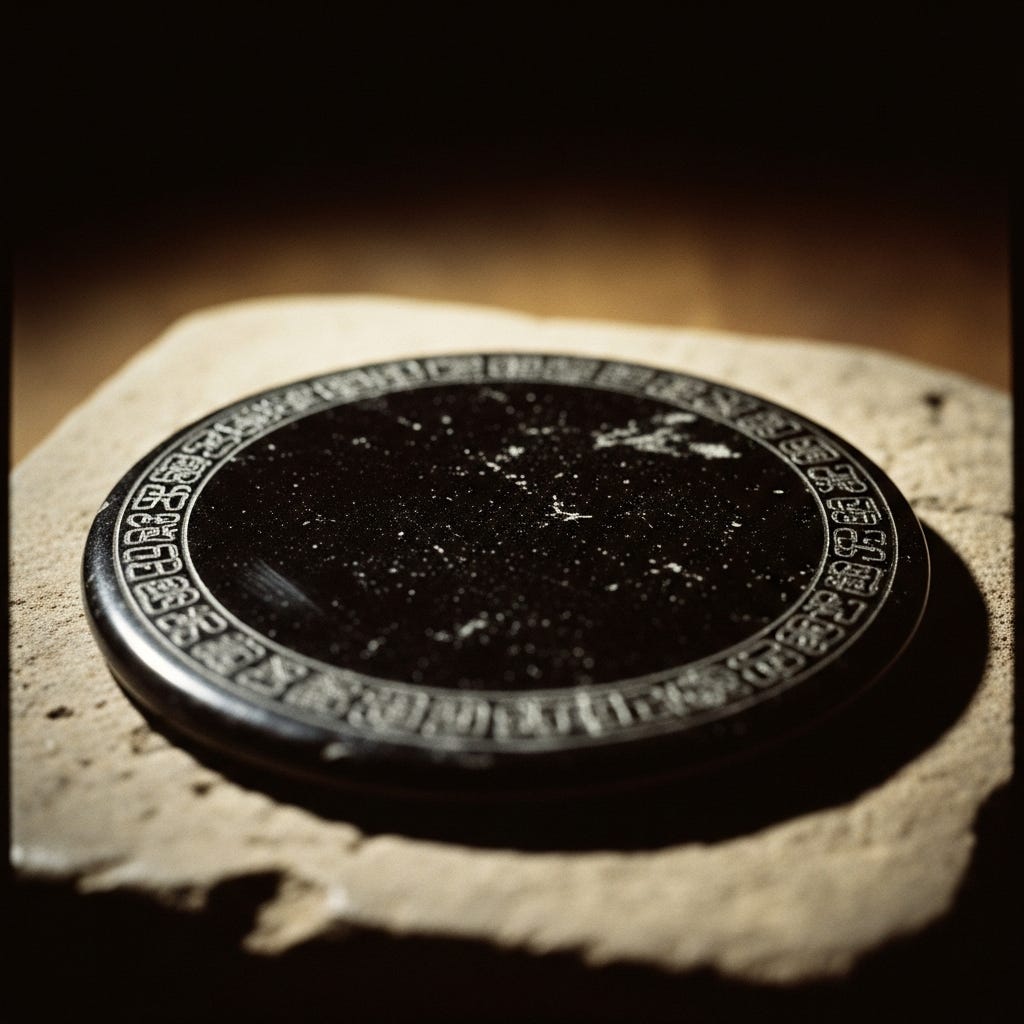
John Dee was the most extraordinary mind of the Elizabethan age. Mathematician, astronomer, navigator, cartographer, and confidant to Queen Elizabeth I — he advised on England’s voyages of discovery and helped lay the intellectual foundations for the British Empire. He was also, by the 1580s, deeply committed to communicating with angels and spirits through scrying, employing a medium named Edward Kelley to gaze into mirrors and crystal balls while Dee meticulously recorded what was seen.
In 2021, geochemical analysis published in the journal Antiquity (Campbell et al.) finally confirmed what had been suspected: Dee’s obsidian mirror originated from Pachuca, Mexico. It was an Aztec artifact, likely brought to Europe after the Spanish conquest of Tenochtitlán in 1521. For the Aztecs, obsidian mirrors were sacred to the god Tezcatlipoca — whose name literally means “Smoking Mirror” — a creation deity associated with kings, warriors, and sorcerers, depicted in codices wearing circular mirrors on his temple, chest, and foot. The mirrors were believed to be doorways to other worlds.
Dee almost certainly knew this. He’d studied accounts of the Spanish encounters in Mexico, and the idea that Tezcatlipoca’s mirrors could grant omniscience would have been irresistible to a man who believed that scrying could reveal divine truth. He acquired the mirror, probably in Bohemia in the 1580s, and used it for the rest of his life.
But Dee was far from the first. Nostradamus reportedly used a bowl of dark water or black oil as his scrying medium in the sixteenth century. Ancient Greeks practiced lecanomancy — divination by gazing into basins of water — and the followers of Pythagoras retreated to pitch-black caves to receive visions through what modern researchers recognize as sensory deprivation. The Oracle at Delphi inhaled vapors and gazed into a reflective surface. Celtic seers used polished beryl crystals. Egyptian priests employed bowls of ink or oil. Arab diviners scryed using their own polished thumbnails.
The obsidian mirror tradition stretches back even further than the Aztecs. Obsidian mirrors appear in Olmec ritual deposits, predating Aztec civilization by over a thousand years. The Classic Maya deity K’awil was so associated with mirror divination that one way to write his name was a hieroglyph of a mirror itself.
Across millennia, across every culture that had access to reflective surfaces, humans independently discovered the same practice: gaze into darkness, quiet the rational mind, and let the deeper intelligence surface.
What You’re Actually Doing Wrong
If you’ve tried scrying and “nothing happened,” you almost certainly made one or more of these mistakes. I know because I made all of them.
You stared too hard. Scrying requires a soft gaze — what painters call “looking past” the surface. If you’re staring at the mirror with the same intensity you’d use to read a text message, you’re engaging the fovea and the analytical visual cortex. You need peripheral, defocused vision — the kind you use when you’re staring out a window without seeing anything specific. This is the gaze that triggers the Ganzfeld effect. It feels like looking at nothing. That’s the point.
You gave up too quickly. The thalamic decoupling that produces scrying visions takes time. Research shows the Ganzfeld state typically establishes within five to seven minutes, with more complex imagery emerging at ten to twenty minutes. If you stared at your mirror for ninety seconds, decided “nothing was happening,” and went to check Instagram, you quit before the neurological shift had time to occur. Scrying requires patience measured in minutes, not seconds.
You didn’t prepare your environment. Scrying works best in low light — dim enough to reduce visual distraction, bright enough to create soft reflection on the mirror’s surface. A single candle placed behind and to the side of you, so the flame reflects in the surface but doesn’t create glare, is ideal. Full darkness or bright room lighting both work against the process. You also need silence or very low, unstructured sound (not music with lyrics or strong rhythms — think brown noise, rain, or absolute silence).
You didn’t prepare yourself. Sitting down to scry when your nervous system is activated — anxious, caffeinated, stressed, just off your phone — is like trying to meditate during a fire alarm. The practice requires a calm baseline. Five minutes of slow breathing, a brief grounding exercise, or even just sitting quietly with your eyes closed before beginning can make the difference between seeing nothing and seeing everything.
You expected a movie. Scrying visions, especially at the beginning, are not high-definition cinematic experiences. They’re subtle. A slight sense of depth or movement in the mirror’s surface. A color that wasn’t there before. A sensation of the darkness shifting. An image that appears for a fraction of a second and dissolves before you can focus on it. If you’re waiting for the mirror to light up like a television screen, you’ll miss the real signals entirely. First experiences are often feelings rather than visuals — a sense of the mirror becoming something other than a flat surface.
Your First Session (The Real Way)
Here’s the protocol that actually works, built on both the historical traditions and the neuroscience of the Ganzfeld state.
The space. Choose a room you can make dim — not black, but dim. A single candle placed about two feet behind you and slightly to one side provides ideal lighting. The candle should be positioned so that a soft glow reflects in the mirror’s surface, creating a point of gentle luminosity within the darkness. Turn off all screens. No phone. No background television. The room should be comfortable temperature — physical discomfort pulls you out of the trance state.
The mirror. Place your scrying surface on a table at a height where you can gaze into it comfortably without tilting your head down sharply (neck strain will distract you within minutes). If using an obsidian scrying mirror, prop it at a slight angle. If using a bowl of water, fill a dark bowl (black ceramic works beautifully) with water and place the candle so its flame reflects in the water’s surface. If using a crystal ball, place it on a dark cloth with the candle behind it.
The preparation. Sit. Close your eyes. Take ten slow breaths — inhale for four counts, exhale for six. This shifts your nervous system into parasympathetic mode. As you breathe, set an intention. Not a demand (”Show me the future!”) but an opening (”I am available to see whatever needs to be seen”). If you work with energetic protection, put your shields up now. Visualize light surrounding you. State internally that you are open only to information that serves your highest good.
The gaze. Open your eyes and let your gaze settle on the mirror’s surface. Don’t stare. Don’t focus. Let your eyes go soft — the way they go soft when you’re daydreaming, looking at nothing in particular. Your goal is to look past the surface, into the darkness behind it, as though the mirror has depth rather than flatness. Blink naturally. Don’t force anything.
The wait. This is where most people quit. For the first three to five minutes, likely nothing will happen. The analytical mind is still running. Inner commentary is still active. Thoughts are still arriving: “This is stupid.” “Am I doing this right?” “My back hurts.” “I should have had dinner first.” Let these thoughts pass without engaging them. They’re your ego’s resistance to the unfocused state that scrying requires. Keep gazing.
The shift. Somewhere between five and fifteen minutes, something changes. The quality of the darkness in the mirror shifts. It may appear to become deeper, cloudier, or to move slightly. Colors may appear at the edges. The mirror may seem to breathe. This is the thalamic decoupling beginning — your brain transitioning from external-input mode to internal-generation mode. Do not react. The moment you think “Oh! Something’s happening!” and engage your analytical mind, you’ll snap out of it. Stay soft. Stay open. Observe without narrating.
The images. If images come, they come on their own schedule. Don’t chase them. Watch them the way you watch clouds — noting shapes, feelings, and impressions without trying to analyze them in real time. Some people see symbolic imagery (animals, faces, landscapes). Some see colors or geometric patterns. Some don’t “see” anything but receive strong intuitive impressions or emotions. All of these are valid scrying experiences. There’s no wrong way to receive.
The close. After fifteen to twenty minutes (set a gentle timer if needed), slowly bring your awareness back to the room. Close your eyes. Take three grounding breaths. Feel your body in the chair. Open your eyes normally, blink, and look around the room to reorient yourself. Then immediately record what you experienced in a journal — images, feelings, colors, impressions, body sensations, anything. The details fade fast, like dreams.
Choosing Your Scrying Medium
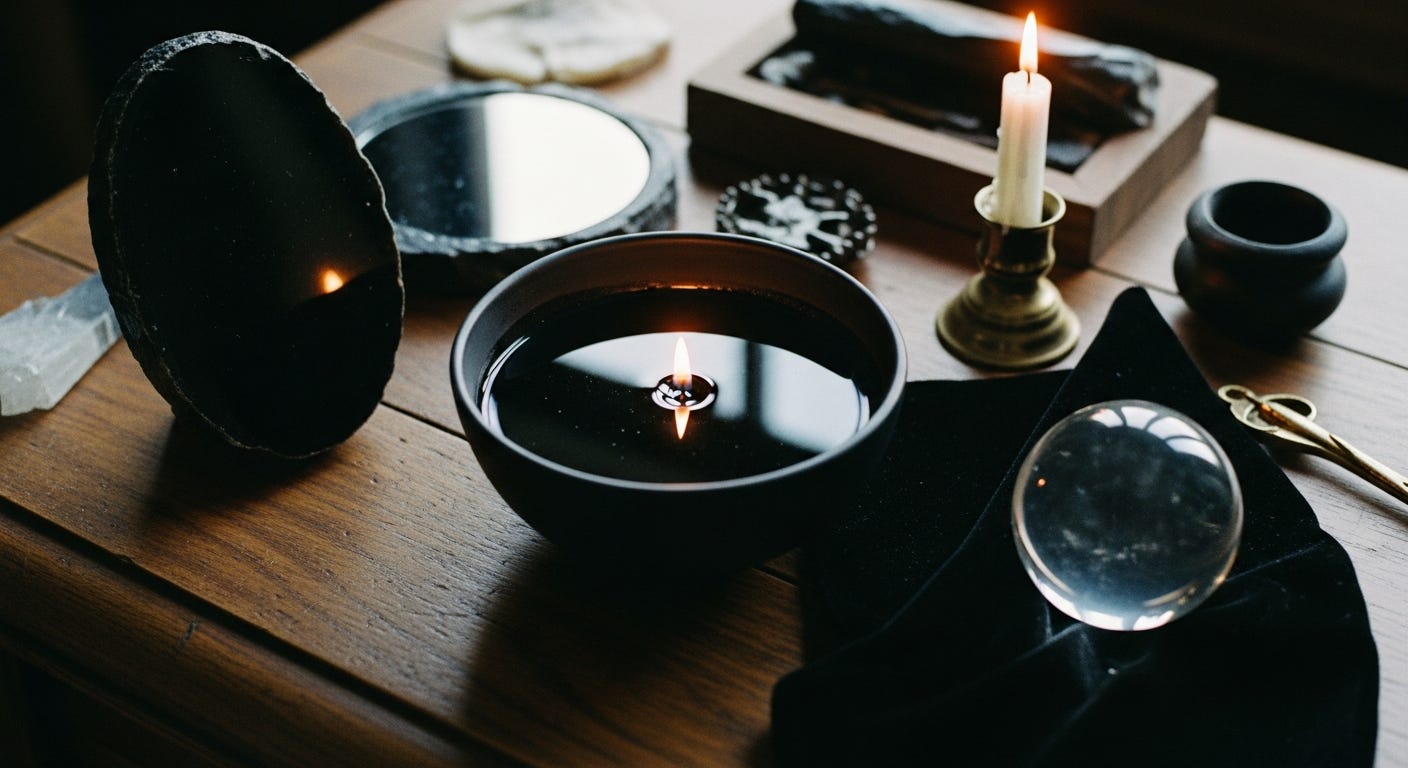
Different surfaces produce different qualities of experience, and the “best” medium is the one that works for your particular brain and sensory style.
Obsidian mirrors are the most traditional scrying tool and my personal recommendation for beginners. The volcanic glass creates a depth of darkness that other surfaces can’t replicate, and obsidian carries energetic properties of protection and grounding that support the vulnerable state scrying requires. A polished obsidian scrying disc between four and six inches is ideal for beginning practice — large enough to gaze into comfortably, small enough to hold or prop on a stand.
Dark water is the oldest and most accessible method. Any dark-colored bowl filled with water works — the ancient Greeks used bronze bowls, Nostradamus reportedly used a small bowl of dark liquid. The advantage of water is that candlelight creates a natural, moving reflection that helps trigger the soft-gaze state. The disadvantage is that water can be knocked over and requires more setup.
Crystal balls work through a different mechanism — the transparency and internal reflections of quartz create a field of subtle visual complexity that the brain can interpret as depth and imagery. Clear quartz balls work well, but amethyst spheres add the intuitive enhancement of amethyst to the scrying process. Crystal balls tend to produce brighter, more colorful visions than obsidian mirrors.
Candle flames are the simplest entry point. Gazing at a single candle flame in a dim room, with soft focus, triggers a version of the Ganzfeld state. The flame itself becomes the scrying field — images appear in and around the flame, in the afterimages when you close your eyes, or in the surrounding darkness. This is how many practitioners naturally discover scrying without realizing they have a name for it.
Black mirrors (any reflective surface painted black on one side) create an intermediate experience between obsidian and clear glass. Some practitioners paint the convex side of a glass plate or small picture frame with black paint, creating a DIY scrying mirror that works surprisingly well. The Wiccans have used this technique for centuries.
Reading What You See
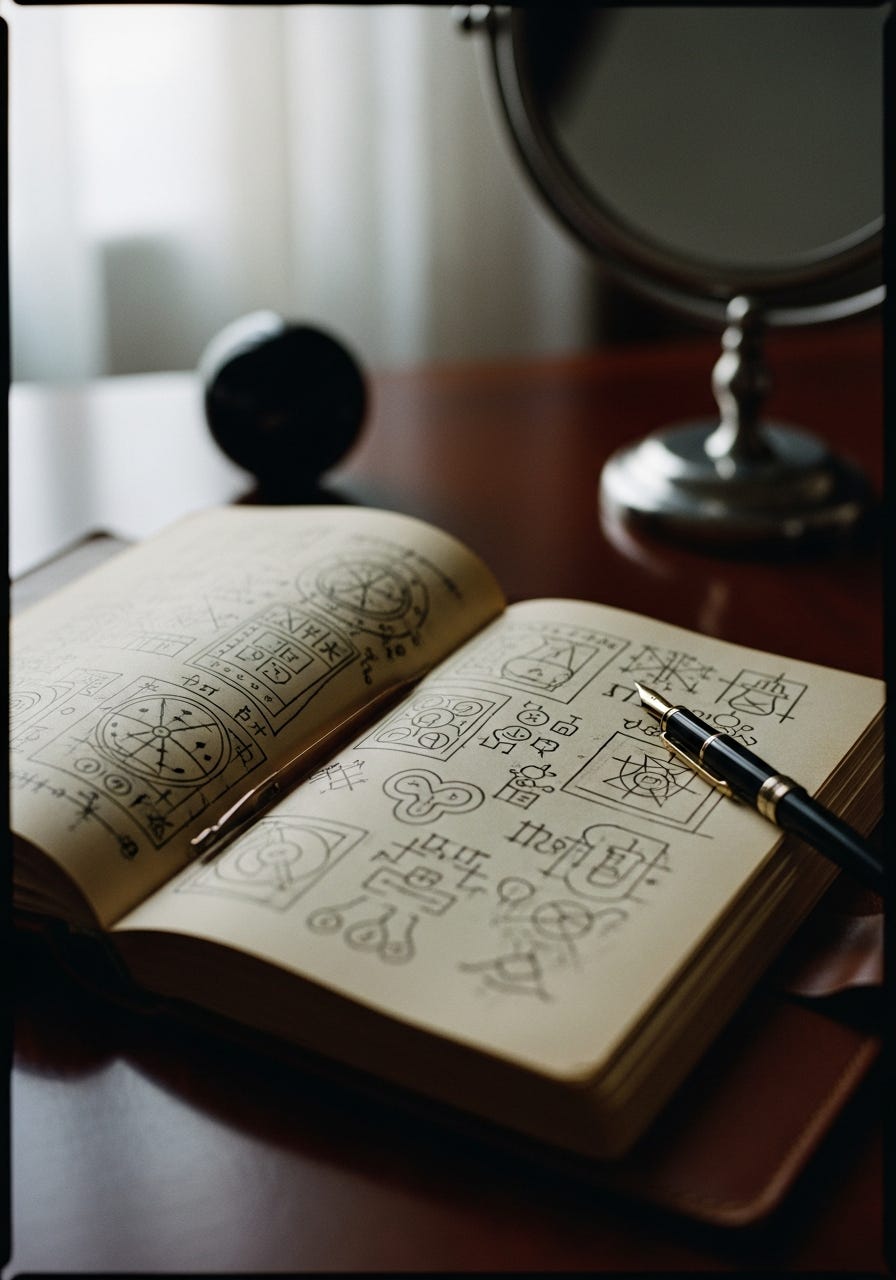
The images that emerge during scrying operate in the same symbolic language as dreams. They are rarely literal. A face doesn’t necessarily mean you’ll meet that person. Water doesn’t necessarily mean a flood. The images are the unconscious mind’s way of communicating in the only language it has — symbol, metaphor, and emotional resonance.
The most important principle of interpretation: your personal associations matter more than any symbol dictionary. If a rose appears and roses remind you of your mother’s garden, that’s a message about your mother — not about romance, which is what a generic dream dictionary would tell you. If you see a door and you’ve been agonizing about a career change, the symbolism is personal and immediate, not abstract.
Keep your scrying journal detailed and consistent. Record: the date, time, moon phase, your emotional state going in, the question or intention you held (if any), everything you saw or felt during the session, and your initial interpretation. Over time, patterns emerge. You’ll discover your personal symbolic vocabulary — the images your unconscious consistently uses to communicate specific themes. This is the real mastery of scrying: not seeing more, but understanding what you see.
Many advanced scryers integrate tarot with scrying — pulling a card before the session as a question or theme to focus on, then using the scrying session to explore the card’s message at a deeper level. The two practices cross-pollinate beautifully, with tarot providing structure and scrying providing depth.
The Ethics and Safety of Looking
Scrying opens a channel between conscious and unconscious mind. Like any open channel, it requires respect and boundaries.
Never scry when you’re emotionally destabilized, severely sleep-deprived, or under the influence of substances. The Ganzfeld state lowers the barriers between conscious and unconscious processing — which is the point — but if your unconscious is currently flooded with unprocessed trauma or acute anxiety, scrying can surface material you’re not equipped to handle alone. Shadow work and scrying complement each other beautifully, but if you’re in the middle of a mental health crisis, put the mirror down and reach out to a professional.
Always ground afterward. The trance state of scrying shifts your consciousness, and coming back without grounding can leave you feeling spacey, disconnected, or emotionally raw for hours. Three deep breaths, feeling your feet on the floor, drinking water, touching something solid — these simple acts close the session and return you to baseline.
Don’t scry for other people without their explicit permission. Gazing into a mirror with someone else’s question or situation as your focus crosses ethical boundaries that practitioners take seriously. If someone asks you to scry for them and you’re willing, treat it with the same respect you’d bring to reading tarot for others — honest, boundaried, and always in service of their autonomy rather than your curiosity.
And if something appears during a session that feels wrong — aggressive, threatening, pushing you to do something, creating fear rather than insight — end the session immediately. Close your eyes, ground yourself, turn on the lights, and cover the mirror. Genuine insight, even difficult insight, arrives with a quality of calm truth. Anything that arrives with a quality of coercion or malice is not worth engaging with, regardless of your interpretation of what it is.
I still have that fourteen-dollar obsidian mirror from Sedona. It lives on my altar now — not tossed between a water bottle and a protein bar, but on black velvet, beside a candle, next to a journal that’s filled with years of cryptic notes and sketches and timestamps.
I never saw my grandmother’s face in it again. But I’ve seen other things — some symbolic, some strange, some so precisely relevant to what I was struggling with that I sat back from the mirror and laughed out loud at the accuracy of my own unconscious mind. The shopkeeper was right: it shows you things you’re not ready for. But it also shows you things you’ve been ready for your entire life and simply hadn’t found the surface dark enough to see them.
Scrying doesn’t require belief. It requires darkness, patience, and the willingness to look at the part of yourself that only speaks in images. The mirror doesn’t see the future. It sees you — the parts that your daylight mind is too busy, too rational, too defended to access. And sometimes, what it shows you in that darkness is exactly the light you needed to find.
What would your unconscious show you if you gave it a dark surface and twenty minutes of silence?
P.S. — You don’t need a fancy mirror to start. Tonight, fill a dark bowl with water, light one candle behind you, and gaze. Five to seven minutes. Soft eyes. No expectations. Whatever happens — or doesn’t — write it down. The practice starts before the visions do.
Related Articles:
Tarot for Beginners: How to Read Cards Without Memorizing 78 Meanings
Psychic Hygiene: Daily Practices to Stop Energy Buildup Before It Wrecks You
Shadow Work: Transform Your Dark Side Into Your Greatest Power
Tarot and Intuition: How to Stop Reading the Book and Start Reading the Cards
Energy Protection 101: The Absolute Basics Every Empath Needs to Master First
Thank you for this great article. I scried years ago without fully preparing or knowing what I was doing and what I saw scared me so bad I never tried again. Now I feel I'm ready to try again with more protection and purpose.
Incredibly informative! I tris scrying with a mirror decades ago, without knowing how to protect myself and what I saw terrified me to the point that I haven’t tried it since. Now that I have more experience and your article, I might just try again. Thank you!