
Candle Magic for Beginners: What You’re Getting Wrong About the Most Powerful Spell You Already Know
Why Your Candle Spells Aren't Working (And the One Shift That Changes Everything)

I watched a white candle burn down to nothing on my kitchen counter at 2 AM, and I felt absolutely nothing.
This was supposed to be the spell that changed things. I’d done everything the Pinterest infographic told me to do. Cleansed my space with sage. Set my intention with crystal-clear specificity. Carved my desire into the wax with a toothpick because I didn’t own a proper carving tool. Anointed the candle with olive oil from my kitchen because the article said “any oil works.” Lit the flame with what I hoped was enough conviction to count as magical focus.
Then I sat there. Watching wax drip. Waiting for something to shift.
The candle took about ninety minutes to burn down completely. I spent most of that time checking my phone, wondering if I was supposed to stare at it the entire time, and fighting the growing suspicion that I was just a grown adult watching a candle melt in the middle of the night for no reason.
Nothing happened. Not that night, not in the days that followed. No signs, no synchronicities, no subtle energy shifts. Just a circle of hardened wax on my counter and the vague sense that I was doing something wrong but didn’t know what.
So I did what any reasonable beginner does — I tried again. Different candle. Different color this time, because maybe the color was the problem. Different intention, more specific. Different oil. I found a “proper” candle magic guide that was longer, more detailed, and used words like dressing and loading that made me feel like I was at least graduating to a more advanced form of failure.
Same result. Wax puddle. No magic.
I almost gave up on candle work entirely. And honestly, looking back, I’m glad those first attempts failed — because everything I thought I knew about candle magic was backwards. I was treating the candle like a vending machine. Insert intention, light flame, receive manifestation. I was so focused on getting the external details right — the color, the oil, the words, the timing — that I completely missed the one thing that actually makes candle magic work.
The candle was never supposed to do the magic. I was.
Here’s what nobody tells you about candle magic: it is simultaneously the most accessible and the most misunderstood form of spellwork that exists. Everyone thinks they know how to do it because the basic mechanics are so simple — light a candle with an intention. But that simplicity is exactly what trips people up. They think simple means easy. They think the candle does the heavy lifting. They think the color correspondence chart is the spell.
It’s not. And once you understand why, candle magic becomes the most powerful practice in your entire toolkit.
I Highly Recommend you check out this Candle Magic For Beginners Course
Fire Has Been Rewiring Your Brain Since Before You Were Human
Before we talk about color charts and carving techniques, we need to talk about what actually happens in your body and brain when you sit in front of a flame. Because this is the part that transforms candle magic from “wishing while wax melts” into something that genuinely changes your internal state — and your external reality along with it.
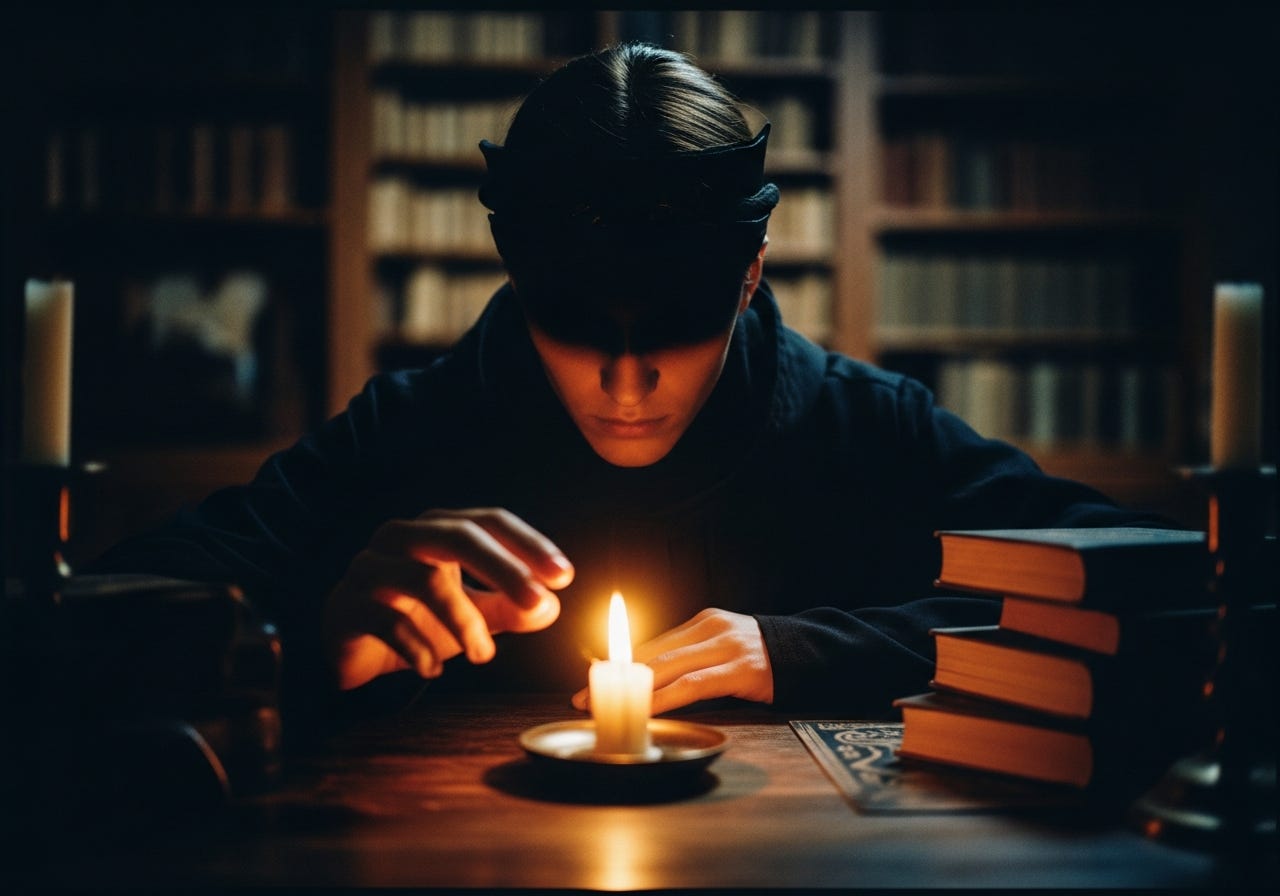
Dr. Christopher Lynn, an anthropologist at the University of Alabama, conducted a series of studies on what happens when people watch fire. Across three studies with over 226 participants, he found that watching a fire with sound consistently lowered blood pressure, and the effect increased the longer participants watched. People who scored higher on measures of absorption — the ability to become deeply immersed in an experience — received the greatest relaxation benefits. This wasn’t a meditation study. This was just people sitting in front of a fire.
The yogic tradition has known this for centuries. Trataka, the practice of candle flame gazing, appears in the fifteenth-century Hatha Yoga Pradipika as one of six purification techniques for preparing the body and mind. Modern research on trataka has found it enhances working memory, spatial attention, selective attention, cognitive flexibility, and response inhibition. A 2024 study published in Explore on Fire Kasina meditation — an advanced form of sustained flame focus — found that the practice produced mystical experience scores comparable to high-dose psilocybin. Participants reported transcendence of time and space, profound shifts in perception, and what researchers carefully termed “emergent phenomena.”
Let me say that differently: staring at a candle flame, done with sustained focus, can produce experiences on par with psychedelic journeys.
This isn’t woo. This is neuroscience confirming what every culture on earth has intuited since our species first sat around a campfire. When you gaze at a flame, your brain shifts from beta waves — the state of active, analytical thinking — through alpha waves, which correspond to relaxation and creativity, and into theta waves, the frequency associated with deep meditation, intuition, and access to the subconscious mind.
Your ancestors didn’t need an EEG to know this. For hundreds of thousands of years, the last thing humans did before sleep was gaze into fire. Psychologist Matt Rossano has argued that this nightly fire-gazing may have actually driven human cognitive evolution — that the meditative state induced by firelight selected for the kind of sustained attention and working memory that made us us.
When you light a candle for spellwork, you’re not performing some obscure occult act. You’re engaging with one of the oldest technologies for altered consciousness that our species possesses. The flame is a doorway to exactly the state of mind where intention becomes more than a thought — where it drops below the surface of conscious awareness and begins to reorganize how you perceive and interact with reality.
This is why just lighting a candle and thinking really hard about what you want doesn’t work. That’s beta-brain activity. You’re essentially trying to cast a spell with the same part of your mind that writes grocery lists. The magic doesn’t happen until you drop below that — until the flame pulls you into the deeper waters where real change is possible.
What Everyone Gets Wrong (And Why It Matters)
The uncomfortable truth about candle magic is that most of what circulates online — the elaborate color charts, the “correct” way to anoint, the precise moon phase timing — focuses almost entirely on external mechanics while ignoring the internal shift that makes any of it matter.
Here’s the most common mistake I see: people treat candle magic like a recipe. Follow the steps correctly, and the spell works. Get a step wrong, and it fails. This creates practitioners who are anxious about “doing it right” rather than present with what they’re doing. They’re so worried about whether they anointed the candle from wick to base or base to wick that they never actually enter the state of consciousness where magic happens.
The second mistake is treating candles as delivery devices for wishes. You carve your intention, light the flame, and the fire carries your desire out into the universe like cosmic mail. This model sounds poetic, but it misunderstands both the candle and the practitioner’s role. The candle doesn’t send anything anywhere. The candle changes you — shifts your brain state, focuses your attention, creates the conditions for your subconscious to receive and act on the intention you’re setting.
The third — and maybe most important — mistake is rushing. A spell candle isn’t a birthday candle. Blowing it out after five minutes of distracted intention-setting and calling it done is like going to the gym, sitting on a bench for five minutes, and wondering why you’re not stronger. The research on fire gazing shows that the effects deepen with time. The longer you stay present with the flame, the more your brain shifts, the more your blood pressure drops, the more your nervous system settles into the state where real transformation becomes possible. If you’re not willing to sit with a candle for at least fifteen to twenty minutes of genuine, sustained attention, you’re leaving most of the magic on the table.
I learned this the hard way. My failed candle spells weren’t failures because I used the wrong color or the wrong oil. They failed because I was performing mechanical actions while my mind was somewhere else entirely. I was going through the motions of magic without actually entering the state that makes magic possible
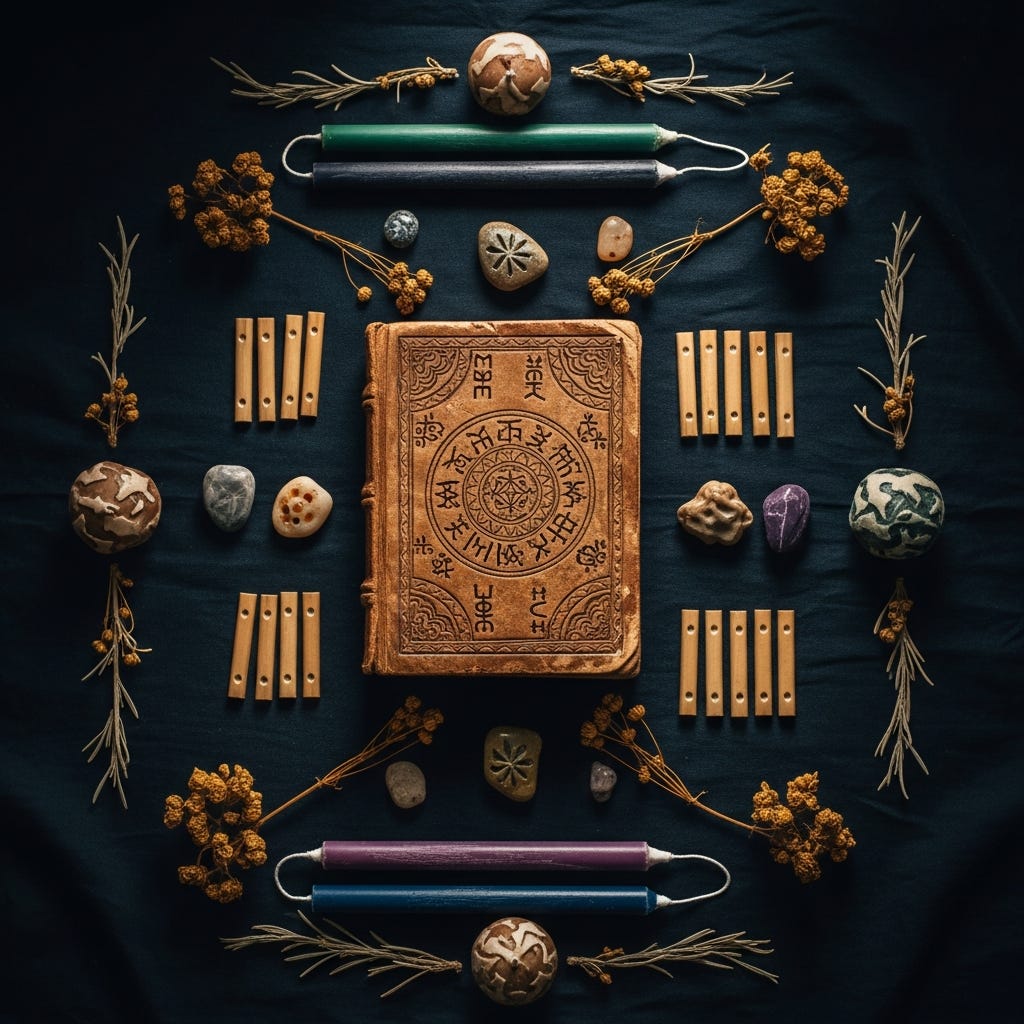
A Lineage That Spans Every Culture on Earth
One of the things that deepens my relationship with candle magic is knowing how many hands have held a flame for the same reasons I hold one now.
The ancient Egyptians were crafting beeswax candles and burning them in temple rituals as early as 3000 BCE, using flame as an offering to deities and a guide for souls in the afterlife. The Romans lit candles for their household spirits — the lares and penates who protected the home. The Greeks burned flames for Artemis, goddess of the moon. In each of these traditions, fire wasn’t just light. It was language. A way of speaking across the boundary between the visible and invisible worlds.
In the African American tradition of hoodoo, candle magic developed its own rich and powerful form, blending West African spiritual practices with Catholic candle lighting in the American South, particularly New Orleans. Colored candles in glass jars — labeled for purposes like “Fast Luck,” “Love Drawing,” and “Road Opening” — became central tools in rootwork. Each candle was dressed with oils and rolled in powders specific to its purpose. This tradition, born from resistance and survival, understood something many modern practitioners miss: the candle doesn’t just carry the intention. The entire process of preparing the candle — choosing it, dressing it, speaking to it, sitting with it — is part of the work. The preparation is the spell.
In Hinduism, the diya — an oil lamp — represents the triumph of light over darkness and knowledge over ignorance. During Diwali, the Festival of Lights, thousands of flames line homes and temples, transforming darkness itself into sacred celebration. In Buddhism, candles burn alongside incense and flowers as offerings symbolizing enlightenment and impermanence. In Mexican and Latin American folk practice, veladoras — devotional candles in glass — are lit for specific petitions, accompanied by prayers to saints. In old Appalachian folk magic, a candle placed in a window guided lost travelers home and kept restless spirits at bay.
Every one of these traditions understood the same fundamental truth: fire changes the quality of space and consciousness. When you light a candle with intention, you’re not inventing something new. You’re joining a lineage that stretches back to the first humans who understood that flame is a doorway.
How Candle Magic Actually Works: The Complete Practice
Now that you understand why candle magic works — the neuroscience, the history, the actual mechanism of consciousness change rather than cosmic wish-delivery — let me walk you through how to practice it in a way that produces real results.
Choosing your candle. Start with chime candles (also called spell candles) — they’re four inches tall, inexpensive, and burn for about one to two hours, which is the perfect duration for focused work. A multi-color spell candle set gives you a full range to work with. Beeswax is ideal if you can find it — it burns cleaner and carries its own warm, honeyed energy — but paraffin works fine. The candle doesn’t need to be expensive or special. It needs to be yours, dedicated to a purpose.
Color does matter, but not in the rigid way most guides present it. Color correspondences evolved from medieval alchemy and planetary associations, and they work through the same psychological mechanism as any symbolic system — they help your mind organize and focus intention. Think of color as a tuning fork, not a requirement. White stands in for any color and is perfect when you’re starting out. Red carries the energy of passion, courage, and desire. Green speaks to growth, abundance, and healing. Black absorbs and banishes — use it for cord cutting and release work. Pink softens things toward love, friendship, and emotional healing. Purple deepens spiritual connection and psychic awareness. Orange ignites creativity, confidence, and swift action. Yellow sharpens the mind for clarity, communication, and study.
If you feel drawn to a color that doesn’t match the “official” correspondence, trust that. Your subconscious is smarter than any chart.
Preparing your candle. This is where most people either skip steps or overcomplicate them. The preparation serves one purpose: to transition you from ordinary consciousness into ritual consciousness. It’s the bridge between “I’m holding a candle” and “I’m entering sacred work.”
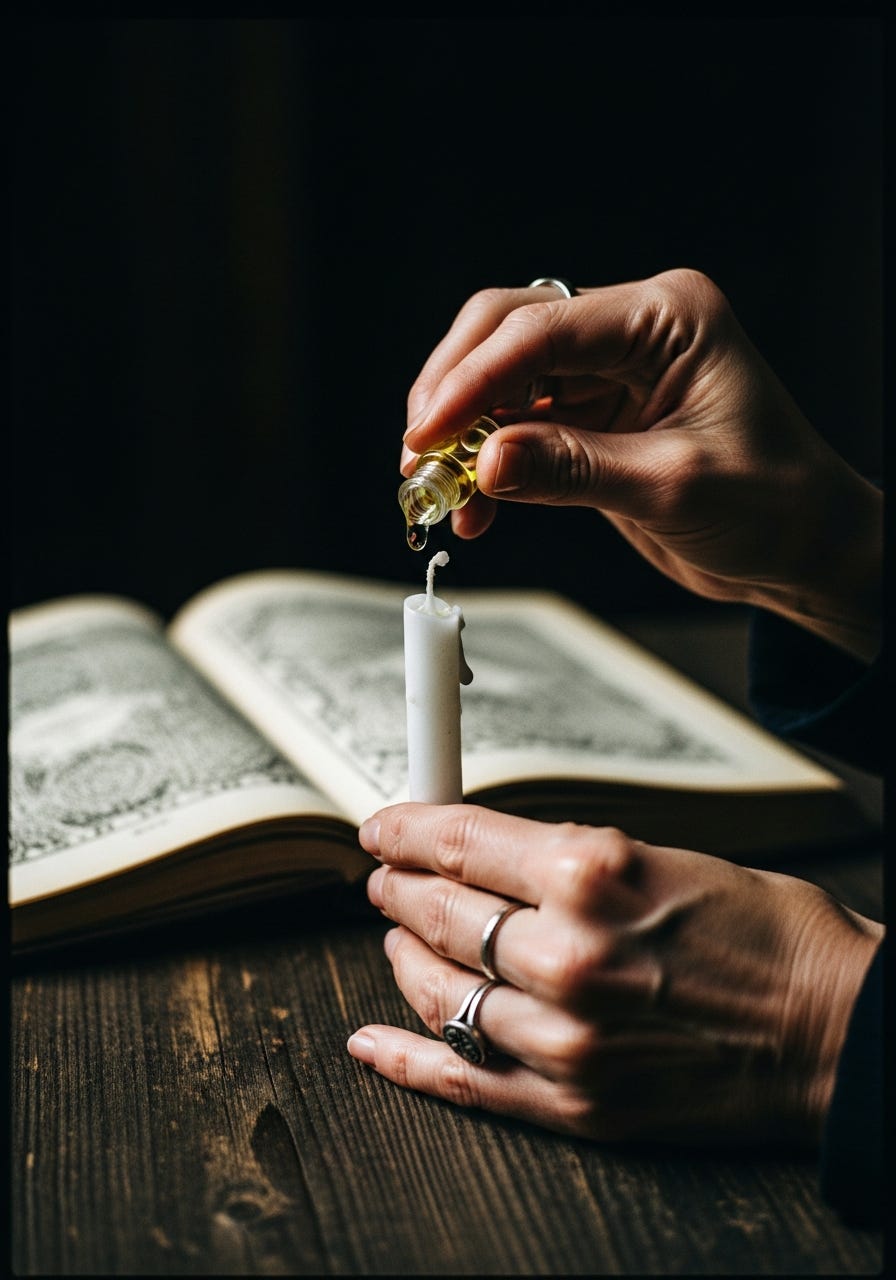
Hold the candle. Feel its weight. Speak your intention to it — out loud, not just in your mind. Something like: This candle carries my intention for clarity about [specific situation]. Keep it simple, specific, and honest. Vague intentions produce vague results. If you wrote an article about manifestation that wasn’t working, this is probably why — the intention was a wish, not a direction.
If you want to carve your candle, use a pin, a toothpick, or a small knife. A word, a symbol, or a sigil you’ve created — all work. The act of carving forces you to slow down and engage physically with your intention, which is the entire point.
Anointing (or “dressing”) the candle means rubbing it with oil while focusing on your intention. Olive oil works. So does coconut oil or any carrier oil you have. If you want to invest in a dedicated candle anointing oil set designed for spellwork, these can add an additional layer of aromatic focus — but they’re not required. The traditional method is to anoint from the center outward to draw things toward you, or from the ends toward the center to push things away. What matters more than the direction is that your hands are on the candle and your mind is on your purpose.
The burn itself. Set up your space. A fireproof plate or dish beneath the candle is non-negotiable for safety. Dim the lights. Silence your phone — not just the ringer, the notifications. This is not the time for half-attention. If you’ve read about psychic hygiene, think of this as an elevated version of clearing your energetic field before deep work.
Light the candle. Speak your intention one more time as the flame catches.
Then sit. Watch the flame. Let your gaze soften — you’re not staring aggressively, you’re settling in. This is trataka. This is what your ancestors did for hundreds of thousands of years before sleep. Let your breathing slow. Let the flame fill your field of vision. Let thoughts arise and pass without following them, the way you would in any meditation practice.
Stay here. This is where the magic happens — not in the carving, not in the oil, not in the color. Right here, in the sustained presence with fire. The first five minutes will feel ordinary. By ten minutes, something shifts. By fifteen or twenty, you’re in a different state entirely. Your nervous system has settled. Your brain has moved from beta to alpha, maybe into theta. The intention you spoke isn’t a thought anymore — it’s become something your whole body is holding.
Reading the flame. Once you’ve settled into the work, you may notice the flame itself communicating. This practice — called lychnomancy or pyromancy — is one of the oldest forms of divination. A steady, tall flame suggests your intention is clear and the energy is flowing without obstruction. A flickering or dancing flame indicates active energy — something is responding, shifting, working. A flame that sputters or pops suggests resistance, either internal or external, that’s worth examining. A flame that burns very low may be telling you the timing isn’t right, or that the intention needs refinement.
Don’t take flame reading as gospel. Take it as feedback worth sitting with.
After the burn. When the candle has burned down — and letting it burn completely in one session is traditional for chime candles — take a moment before you move. Notice what you feel. Notice what’s different in your body compared to when you started. Some practitioners read the leftover wax (carromancy) for additional insight. Wax that runs cleanly with no residue suggests a clear working. Unusual shapes in the remaining wax can be interpreted intuitively.
Then let it go. This is the same principle that makes sigil magic work — once the intention is set and the work is done, release it. Don’t obsess over results. Don’t do the same spell five nights in a row because you’re anxious about whether it worked. Trust the process, then move on.
Building a Real Practice: Beyond the Single Spell
The single-candle spell is where most people start, and many never move beyond it. But candle magic has depth that can sustain years of practice.
Seven-day candle work. For intentions that need sustained energy — major life transitions, deep healing, long-term goals — work with a pillar or jar candle over seven days. Light it at the same time each day, sit with it for fifteen to twenty minutes, then extinguish it (pinch or snuff, never blow — blowing scatters the energy). Each session builds on the last, creating a cumulative shift that single-session work can’t match. A seven-day ritual candle in glass designed for petition work makes this accessible.
Candle magic and moon phases. Your candle work amplifies when you align it with lunar cycles. Waxing moon (new to full) for drawing things toward you — abundance, love, opportunity, growth. Waning moon (full to new) for releasing, banishing, cutting ties, ending patterns. Full moon for charging and amplifying. New moon for setting fresh intentions. This isn’t rigid doctrine — it’s rhythmic support. Working with the moon doesn’t make your candle spell more “valid.” It adds the energy of natural cycles to what you’re already doing.
Combining candle magic with other practices. This is where things get powerful. Burn a candle while journaling shadow work and the inner work goes deeper because you’re already in an altered state. Use a candle as the focal point for an energy cleansing session. Pair a candle with a crystal that matches your intention — a clear quartz point amplifies any candle working, while a rose quartz brings warmth to love and self-compassion work. Place your intention-carved candle on top of a written petition. Surround it with herbs that correspond to your goal — cinnamon for abundance, rosemary for clarity, lavender for peace. Each element you add creates another point of focus for your attention, another layer of symbolic resonance for your subconscious to work with.
Recording your work. Keep a grimoire or spell journal dedicated to your candle work. Record the date, moon phase, candle color, intention, duration of your sit, what you noticed about the flame, what you felt during and after, and any results that follow in the days and weeks ahead. Over time, patterns emerge. You’ll learn which colors resonate most powerfully for you personally (which may differ from the standard charts). You’ll notice which moon phases support your work best. You’ll develop a relationship with flame that goes far beyond following instructions — and that relationship is where the real magic lives.
Your First Candle Spell (Do This Tonight)
You don’t need special tools. You need a candle, a quiet space, and twenty minutes.
Choose a white candle if you don’t have colored ones. Tea lights work. Birthday candles work. Anything with a flame works.
Hold the candle. Think of one thing you want to invite into your life — not a vague wish, but a specific quality or shift. Speak it out loud: I invite clarity into my decision about ___. I invite courage to face ___. I invite peace in my relationship with ___. One intention. Simple. Honest.
Place the candle on a safe surface. Light it. Sit with it. Watch the flame. Let your eyes soften. Let your breathing slow. Stay here for fifteen minutes minimum. If your mind wanders, gently bring your attention back to the flame — exactly like meditation, because that’s what this is. Notice what you feel in your body. Notice what thoughts or images arise without chasing them.
When you’re ready, let the candle burn out on its own or extinguish it with a snuffer or by pinching the wick. Take three deep breaths. Notice the quality of silence in the room after the flame is gone.
That’s it. That’s candle magic. Not the color chart. Not the oil. Not the carving. The act of sitting with fire and intention long enough for something inside you to shift.
Everything else — the correspondences, the timing, the herbs and oils and crystals — those are tools to help you go deeper into what you just experienced. They matter. But they matter because they deepen the core practice, not because they replace it.
I think about that 2 AM candle sometimes. The one that burned down to nothing while I checked my phone and waited for the universe to deliver.
The candle did exactly what it was supposed to do. It burned. It offered me a doorway into a different state of consciousness, a chance to drop below the surface noise and plant something real in the deeper soil of my awareness. I just didn’t walk through that doorway. I stood outside it, performing the gestures of magic while my mind stayed in its ordinary, distracted, wish-making mode.
Now I sit with candles differently. I don’t check my phone. I don’t rush. I don’t worry about whether I’m doing it right. I show up. I speak what’s honest. I watch the flame. I let it change me. And then I let it go.
That’s the practice. And the more you do it, the more you realize the flame has been waiting for you all along — the way it waited for every human who ever sat before a fire and felt the boundaries of ordinary consciousness begin to soften. The way it’s waiting for you right now.
Light the candle. Sit down. Stay.
What was the first candle you ever lit with intention — even if you didn’t call it magic at the time? I want to hear about it in the comments.
P.S. — If you’ve tried candle magic before and felt like nothing happened, I’d be willing to bet you were doing everything right except the one thing that matters most. Go back to that section about the actual burn and try it again with the timer set for twenty minutes. Then come back and tell me what shifted.
Related Articles
Sigil Magic for Beginners: The Most Powerful Spell You Can Cast With Nothing But a Pen
The Reality of Manifestation: Why Your Spells Aren’t Working
Psychic Hygiene: Daily Practices to Stop Energy Buildup Before It Wrecks You
Moon Phase Magic: Working with Lunar Cycles That Actually Transform Your Practice
Energy Cleansing: A Witch’s Guide to Resetting Your Space, Mind & Spirit
This was such an informative article. I have a new and clear understanding and direction for candle magic now. Now I’m looking forward to restarting the practice I had put away. Thank you!